
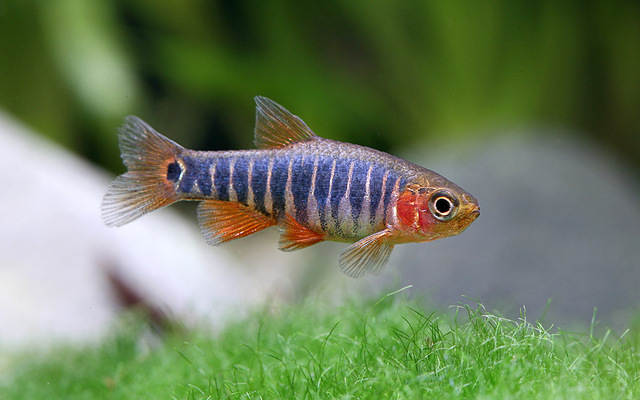
The Boraras naevus, also known as the Strawberry Rasbora, is a diminutive cyprinid originating from slow‑moving, plant‑rich waters in Southeast Asia. Its intense red coloration and contrasting dark lateral spots give a striking visual effect, especially when kept in a well‑planted aquascape with subdued lighting. Thanks to its peaceful temperament and small size, it is a very popular choice for nano aquariums and carefully designed planted tanks.
Ideal aquarium setup
To keep this species successfully, provide a densely planted aquarium with fine‑leaved plants, floating plants and some branches or roots to diffuse the light and create shaded areas. A minimum tank volume of 30–40 L is recommended, but larger tanks offer more stable water parameters and allow a larger shoal, which helps reduce shyness. Gentle filtration is essential: these fish come from sluggish waters and do not appreciate strong currents, so a sponge filter or low‑flow internal filter is ideal.
For beginners, using a dark substrate and plenty of hiding places (wood, leaves, mosses) will make the fish feel secure and bring out their best coloration. Regular maintenance with small, consistent water changes helps maintain water quality and avoids sudden parameter swings to which this species can be sensitive.
Water parameters and compatibility
Boraras naevus thrives in soft, slightly acidic to neutral water, with a pH in the approximate range of 5.0–7.0 and a temperature between 25–28 °C. Hardness should remain in the soft to moderately soft range, and nitrate values should be kept reasonably low through good filtration and regular maintenance.
This is a peaceful schooling fish that should always be kept in groups of at least 6–10, with larger groups of 12 or more recommended to encourage natural behaviour and confidence. Suitable tank mates include other very small, calm species such as small rasboras, small peaceful shrimp and snails; avoid large or boisterous fish that may intimidate or outcompete them.
Feeding and routine care
In nature, Boraras naevus behaves as a micropredator, feeding on tiny invertebrates and zooplankton. In the aquarium, it readily accepts high‑quality micro pellets, crushed flakes and small frozen or live foods such as Daphnia and Artemia nauplii, and a varied diet will help maintain health and coloration. Feed small portions 1–2 times per day, ensuring that all food particles are small enough for their tiny mouths.
For beginner aquarists, it is advisable to use a liquid test kit to monitor pH, temperature and nitrate levels regularly and to perform modest weekly water changes rather than large, infrequent ones, as this species can react poorly to abrupt changes. With stable conditions and gentle handling, Strawberry Rasboras can live several years and will reward the aquarist with active schooling behaviour and vivid colours.
Reviews
There are no reviews yet.